Skip to documentation content
Soul Terminal

Documentation

⌘ / Ctrl K
Open Terminal

Start here

  • Introduction
  • Products and features

Soul Terminal

  • Feeds, scans and charts

Soul Scanner

  • Scanner overview
  • Scanner guide
    • Start a scan
    • Alerts and warnings
    • Field glossary
    • Fake Holder
    • Fake Volume
    • Bundles
    • Snipers
    • First 20
    • Group Trading
    • Auto Track
    • Trench Track

Soul Trending

  • Soul Trending
    • Early Trending
    • Whale Trending
    • Trench Trending

Soul Sniper

  • Trade with Sniper
    • Limit and auto orders
    • Tracking-linked orders

Share and get help

  • Community
  • Contact
  • Team

Understand limits

  • Terms
  • Disclaimers
    • Trending disclaimer
  • Privacy policies

Interactive guides

  • Interactive Soul guides
    • Interactive Scanner scan guide
    • Soul Scanner command guide
    • Soul Sniper command guide
    • Soul Trending guides
      • Trending basics: What Trending is
        • Trending basics: Recognize the posts
        • Trending basics: From alert to research
        • Trending basics: Your next step
      • Early Trending: Start with Early Trending
        • Early Trending: Read an entry alert
        • Early Trending: Read updates and rankings
        • Early Trending: Your next step
      • Whale Trending: Read the wallet signals
        • Whale Trending: Wallet and Scan
        • Whale Trending: Read updates
        • Whale Trending: Your next step
      • Trench Trending: Start with Trench Trending
        • Trench Trending: Read the entry fields
        • Trench Trending: Read updates
        • Trench Trending: Your next step

Start here

  • Introduction
  • Products and features

Soul Terminal

  • Feeds, scans and charts

Soul Scanner

  • Scanner overview
  • Scanner guide
    • Start a scan
    • Alerts and warnings
    • Field glossary
    • Fake Holder
    • Fake Volume
    • Bundles
    • Snipers
    • First 20
    • Group Trading
    • Auto Track
    • Trench Track

Soul Trending

  • Soul Trending
    • Early Trending
    • Whale Trending
    • Trench Trending

Soul Sniper

  • Trade with Sniper
    • Limit and auto orders
    • Tracking-linked orders

Share and get help

  • Community
  • Contact
  • Team

Understand limits

  • Terms
  • Disclaimers
    • Trending disclaimer
  • Privacy policies

Interactive guides

  • Interactive Soul guides
    • Interactive Scanner scan guide
    • Soul Scanner command guide
    • Soul Sniper command guide
    • Soul Trending guides
      • Trending basics: What Trending is
        • Trending basics: Recognize the posts
        • Trending basics: From alert to research
        • Trending basics: Your next step
      • Early Trending: Start with Early Trending
        • Early Trending: Read an entry alert
        • Early Trending: Read updates and rankings
        • Early Trending: Your next step
      • Whale Trending: Read the wallet signals
        • Whale Trending: Wallet and Scan
        • Whale Trending: Read updates
        • Whale Trending: Your next step
      • Trench Trending: Start with Trench Trending
        • Trench Trending: Read the entry fields
        • Trench Trending: Read updates
        • Trench Trending: Your next step

User Guides

Fake Volume

Understand the Fake Volume amount and percentage, their limits, and one historical Scanner result.

Read Fake beside Vol to understand the volume amount flagged by the scan and its reported share. Confirm the token and chain first. This explanation covers the Solana result shown below. Availability and presentation can vary by chain.

What it measures

In volume context, Fake: $X [Y%] reports a dollar amount of flagged trading volume for the reported one-hour period. When shown, Y% expresses the reported flagged amount as a share of the one-hour volume used in that result. Amounts and percentages are rounded for display.

This is a trading-volume measurement. It does not count holders or measure their share of token supply. The Fake field beside Hodls is the separate Fake Holder measurement.

The one-hour label describes the reported period. It does not guarantee that the amount and total cover exactly the same trades or observation times.

Read the amount and any percentage from the same returned result. Availability and update timing can vary; the scan does not establish complete coverage of all trading.

What it cannot tell you

Fake is a detector label, not a verdict. The amount does not identify people, establish common ownership, or prove that trades were deceptive. It also does not prove that the remaining volume came from independent buyers or genuine demand.

An absent field is unavailable, not a reported zero. A displayed $0 is a reported value, not proof that no flagged activity occurred or that coverage was complete. If the amount or percentage is missing, keep that part unknown. Do not reconstruct a missing percentage from rounded amounts.

The number alone does not establish token safety or predict a price move.

One worked example
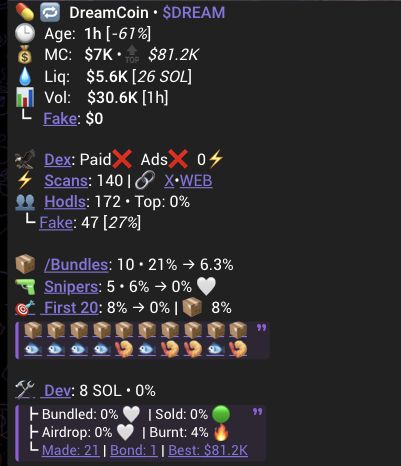
Historical DREAM Scanner result showing Vol: $30.6K [1h] and volume-context Fake: $0.
Scanner capture retained from 21 October 2026. Its release identity is unverified. These are historical displayed values, not a live token result.
Unchanged market-field crop from the result above, including Vol: $30.6K [1h] and Fake: $0.
The same result's volume fields. No Fake Volume percentage is displayed.

The capture shows Vol: $30.6K [1h] and Fake: $0, with no percentage beside Fake.

Read this as: the result reports about $30,600 of one-hour volume and displays $0 for flagged volume. Keep the missing percentage unknown. The screenshot does not establish why the amount is zero, verify the underlying records, or prove that all $30,600 was genuine trading.

The separate Fake: 47 [27%] beside Hodls describes flagged-address counts. It is not the percentage of fake trading volume in this example.

Return to your original scan and read Fake with its one-hour Vol value. If a field is absent, continue with the available activity information without assuming zero. Check an independent reference when an important conclusion depends on activity outside the scan.

PreviousFake HolderNextBundles

On this page

  1. What it measures
  2. What it cannot tell you
  3. One worked example